
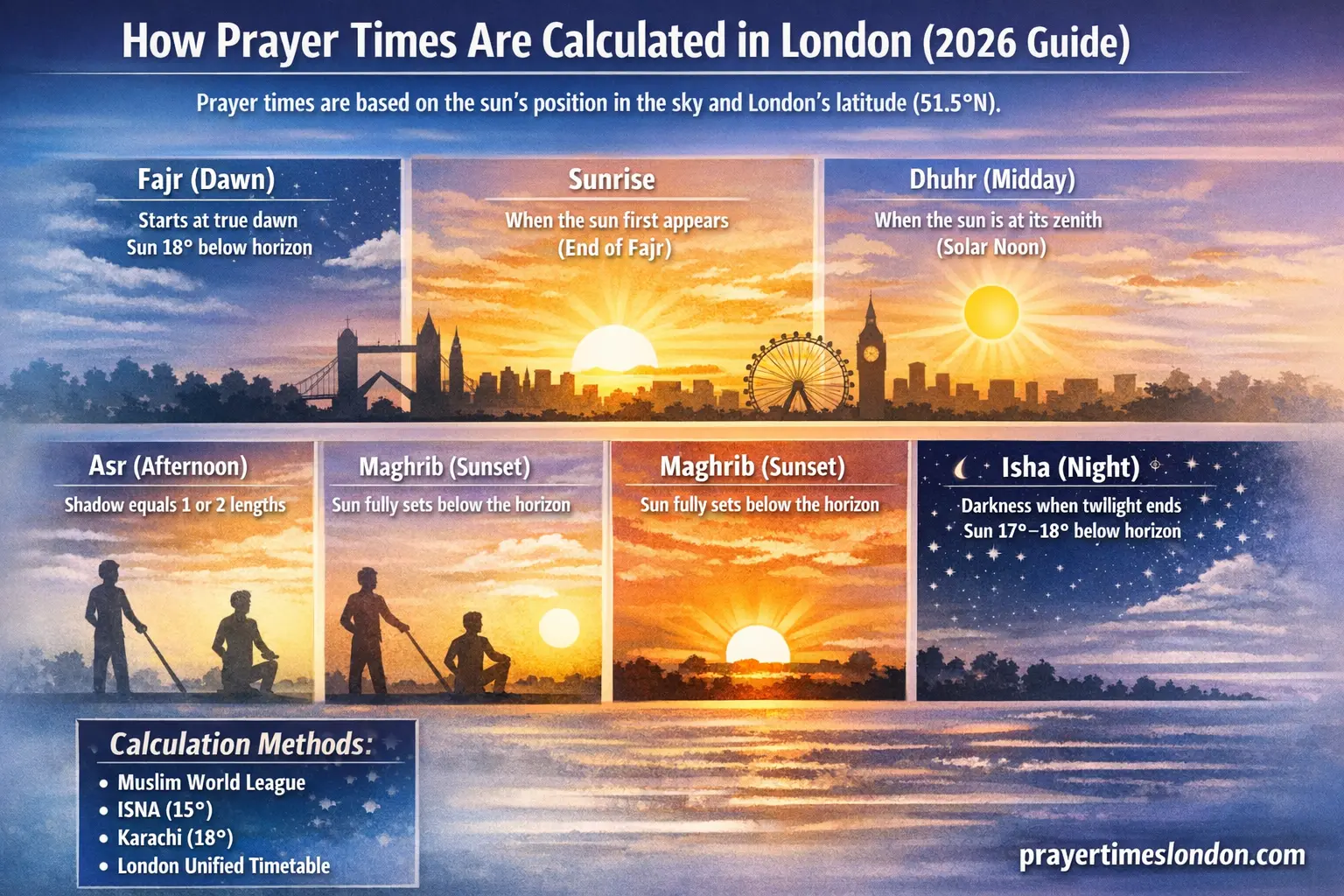
How Prayer Times Are Calculated in London (2026 Guide)
Prayer times in London in 2026 are calculated based on the position of the sun and London’s geographical latitude (51.5°N). They are not fixed clock times — they shift slightly every single day.
Because London is located further north than many Muslim-majority countries, seasonal changes significantly affect Fajr and Isha throughout the year. Also, Islamic Center of England approves of this.
In this guide, we explain exactly how each of the six daily prayer times is determined using solar position.
Why London’s Location Affects Prayer Times
London’s northern latitude causes:
- Very early Fajr during summer
- Very late Maghrib in June and July
- Large seasonal variation between winter and summer
- Longer twilight periods compared to equatorial countries
In 2026, these variations will again be noticeable, especially between January and June.
Prayer times are calculated using astronomical formulas based on:
- Solar angle
- Solar noon
- Twilight disappearance
- Shadow length
The Six Daily Prayer Times Explained
Each prayer begins when the sun reaches a specific position in the sky — not at a fixed clock time.
Fajr (Dawn Prayer)
Definition: Begins at true dawn, when the first horizontal light appears on the eastern horizon.
Astronomical calculation:
The sun is approximately 18° below the horizon (depending on the calculation method used).
In London (2026):
- Summer: Around 2:30–3:30 AM
- Winter: Around 6:00–7:00 AM
Because twilight lasts longer in northern cities like London, Fajr becomes extremely early during peak summer months.
Sunrise (Shurooq)
Definition: When the upper edge of the sun first becomes visible above the horizon.
Important:
- Sunrise marks the end of Fajr time
- Prayer is not permitted at sunrise
Sunrise gradually shifts earlier from winter to summer and later again towards winter.
Dhuhr (Midday Prayer)
Definition: Begins when the sun passes its highest point in the sky (solar zenith).
This moment is known as solar noon — and it is not always exactly 12:00 PM.
In London 2026:
Dhuhr typically falls between 11:45 AM and 1:15 PM depending on the season and Daylight Saving Time.
Asr (Afternoon Prayer)
Definition: Begins when the shadow of an object reaches a specific length.
There are two main methods used in London:
Standard method (Shafi, Maliki, Hanbali):
Shadow equals the object’s length.
Hanafi method:
Shadow equals twice the object’s length.
Because of this difference, Asr time can vary by 30–60 minutes between different mosques in London in 2026.
Maghrib (Sunset Prayer)
Definition: Begins immediately after the sun fully sets below the horizon.
In London 2026:
- Summer: Around 9:00–9:30 PM
- Winter: Around 3:50–4:30 PM
Maghrib is one of the most precise prayer times because sunset is clearly observable.
It also marks:
- The end of fasting during Ramadan
- The beginning of the evening
Isha (Night Prayer)
Definition: Begins when twilight completely disappears and the sky becomes fully dark.
Astronomical calculation:
The sun is approximately 17°–18° below the horizon.
Important for London:
During peak summer in June, complete darkness may barely occur due to extended twilight.
Because of this:
- Some mosques adjust Isha timing
- Some follow angle-based methods
- Some use fixed intervals after Maghrib
This explains why Isha times may differ slightly across London in 2026.
Prayer Time Calculation Methods Used in the UK (2026)
Different organizations use slightly different solar angles for Fajr and Isha.
Common methods include:
- Muslim World League (18°)
- ISNA (15°)
- University of Islamic Sciences Karachi (18° Fajr / 18° Isha)
- London Unified Timetable adjustments
Because of these variations, two websites may differ by 5–20 minutes — especially for Fajr and Isha.
How Daylight Saving Time Affects Prayer Times in 2026
In 2026, the UK will switch:
- To British Summer Time (BST) in late March
- Back to GMT in late October
Important:
Daylight Saving Time does not change the sun’s position.
It only shifts the clock time shown.
Prayer times are always calculated astronomically — the displayed local time simply adjusts with DST.
Why Prayer Times Change Every Day
The Earth’s orbit around the sun is slightly tilted and elliptical.
Because of this:
- Sunrise and sunset shift daily
- Solar noon changes slightly
- Twilight duration varies throughout the year
This causes daily prayer times in London to gradually move earlier or later across 2026.
Why Mosque Prayer Times May Differ
Mosques may:
- Add a 5–20 minute delay for Iqamah
- Use slightly different calculation methods
- Apply community-based adjustments
- Follow unified London timetables
Always check whether the time displayed is:
- Adhan time (start of prayer window)
- Or Jama’ah time (congregational prayer)
Final Summary
Prayer times in London in 2026 are determined entirely by:
- The sun’s position
- London’s latitude (51.5°N)
- The selected calculation method
- Daylight Saving Time adjustments
Fajr and Isha vary the most throughout the year.
Maghrib and Sunrise are the most precise.
Asr varies depending on madhhab method.
Understanding this helps Muslims in London confidently follow accurate and reliable prayer times throughout 2026.
Frequently Asked Questions (FAQs)
Why are prayer times different in London compared to other countries?
Prayer times are based on the position of the sun. Because London is located at a high northern latitude (51.5°N), sunrise, sunset, and twilight behave differently compared to countries closer to the equator. This causes Fajr to be very early in summer and Maghrib to be very late.
Why is Fajr so early in London during summer 2026?
During summer, London experiences very long daylight hours and extended twilight. The sun does not descend far below the horizon at night, which makes true dawn occur very early — sometimes before 3:00 AM in June 2026.
Why do different websites show slightly different prayer times for London?
Different websites use different calculation methods for Fajr and Isha (such as 15°, 17°, or 18° solar angles). Small differences in astronomical models or rounding can also cause prayer times to vary by 5–20 minutes.
Why do mosque prayer times differ from online prayer times?
Mosques often add a delay between Adhan (start time) and Iqamah (congregational prayer). Some mosques also follow specific calculation methods or local community timetables, which may differ slightly from online calculators.
Does Daylight Saving Time affect prayer times in London?
Daylight Saving Time does not change the sun’s position. It only shifts the clock forward or backward. Prayer times remain astronomically calculated, but the displayed time changes when the UK switches between GMT and BST in 2026.
What is the earliest Fajr time in London in 2026?
The earliest Fajr in London typically occurs in mid-June. Check it at prayertimeslondon.com!
Why is Isha so late in London during summer?
Because London is far north, twilight lasts much longer in summer. The sun does not drop deeply below the horizon, which delays complete darkness. This makes Isha much later — sometimes close to 11:00 PM in peak summer 2026.
Which calculation method is most commonly used in London?
Many UK mosques use variations of the Muslim World League (18°) or local unified timetables. However, some communities follow ISNA (15°) or other scholarly opinions.
Do prayer times change every day in London?
Yes. Prayer times shift slightly every day due to the Earth’s orbit and tilt. Sunrise, sunset, and twilight times gradually move earlier or later throughout the year.