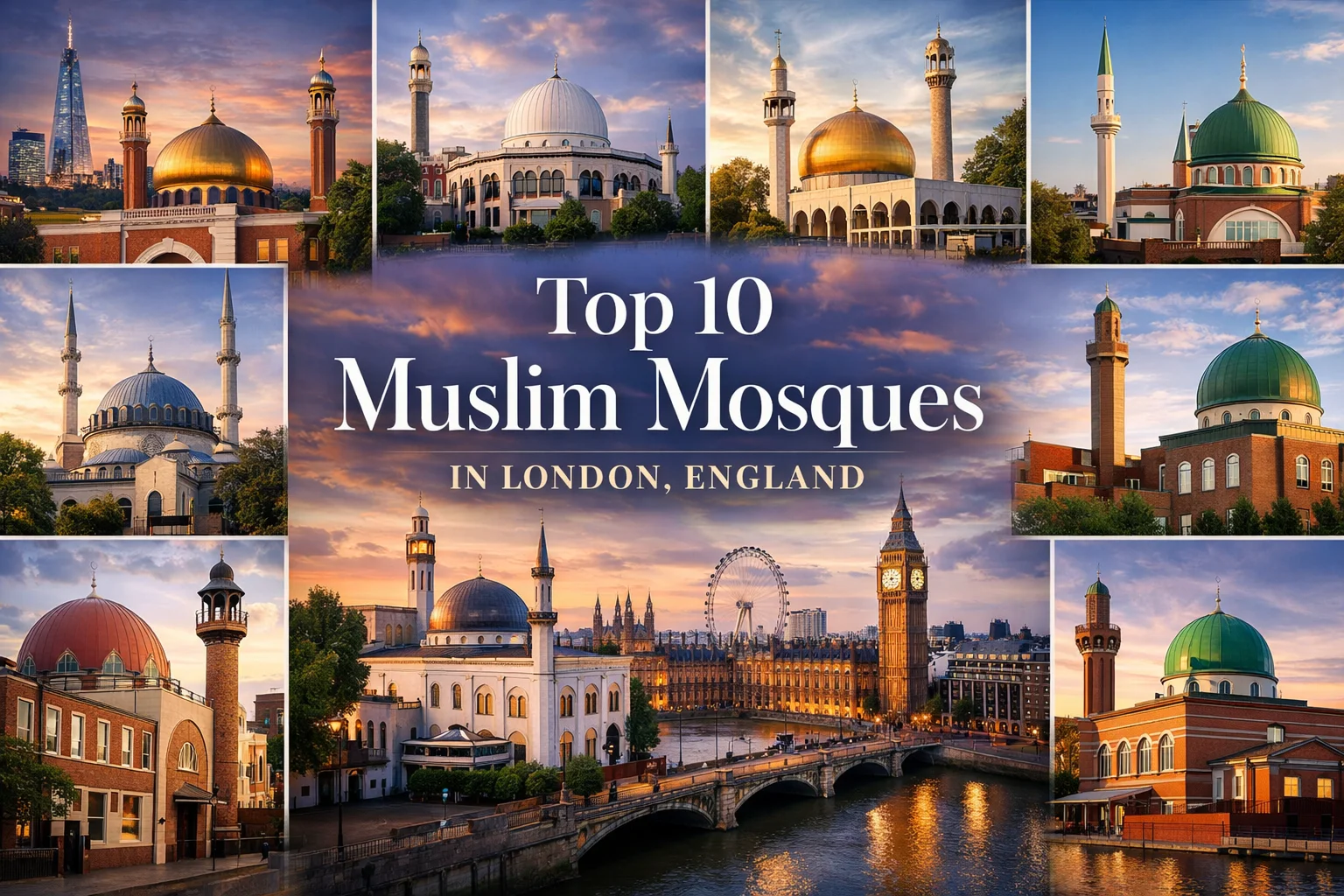
Top 10 Muslim Mosques in London, England
London stands as one of Europe’s most diverse capitals, with a Muslim population exceeding 1.3 million across the Greater London area . You can check its salah timings at Prayer Times London. This vibrant Islamic community has established remarkable places of worship that serve not only as spiritual centers but as vital community hubs offering education, social services, and interfaith dialogue. Whether you’re a Muslim resident seeking a new masjid, a visitor interested in Islamic architecture, or a researcher studying Britain’s religious landscape, this guide presents the ten most significant Muslim mosques in London, England, ranked by historical importance, capacity, community impact, and architectural significance.
1. East London Mosque & London Muslim Centre (Whitechapel)
Capacity: Approximately 10,000 worshippers | Established: 1910 (original), 1985 (current building), 2004 (London Muslim Centre) | Location: 82-92 Whitechapel Road, E1 1JQ
The East London Mosque (ELM) stands as the undisputed cornerstone of British Islam. Founded in 1910, it represents one of the UK’s oldest Islamic institutions, though the current purpose-built facility opened in 1985. You can check its salah timings at Prayer Times London.
The adjacent London Muslim Centre (LMC), inaugurated in June 2004 with Prince Charles launching the construction project, transformed the complex into Western Europe’s largest Islamic center, accommodating nearly 10,000 worshippers during Friday prayers .
The mosque serves Tower Hamlets’ predominantly Bangladeshi British community, though it welcomes Muslims of all ethnicities. During Ramadan 2024, the mosque distributed over 10,000 iftar meals and raised significant funds for Gaza relief efforts.
The ELM has won multiple awards, including the 2024 Best Convert Care Shortlisted Mosque by Beacon Mosque .
2. Baitul Futuh Mosque (Morden)
Capacity: 13,000 people | Opened: October 3, 2003 | Location: 181 London Road, Morden, SM4 5PT
Baitul Futuh—translated as “House of Victories”—holds the distinction of being the largest mosque in the United Kingdom and among the largest in Western Europe. You can check its salah timings at Prayer Times London.
Serving as the headquarters of the Ahmadiyya Muslim Community UK, this architectural marvel accommodates 13,000 worshippers across its 5.2-acre complex.
Architectural Significance:
Following a devastating fire in September 2015 that destroyed the administrative wing, the mosque underwent a £20 million redevelopment completed in March 2024, featuring state-of-the-art facilities designed by John McAslan + Partners (architects of King’s Cross Station).
The complex includes a library, museum, gym, radio and television studios broadcasting the Head of the Ahmadiyya Community’s weekly sermons globally, and extensive community halls.
The mosque’s motto “Love for all, hatred for none” manifests through its homeless feeding programs, annual Peace Conferences, and hosting BBC Radio 4’s Question Time.
3. London Central Mosque (Regent’s Park)
Capacity: 5,000+ worshippers | Opened: July 1977 | Location: 146 Park Road, NW8 7RG
Commonly known as Regent’s Park Mosque, the London Central Mosque serves as the spiritual focal point for Muslims throughout the UK.
Its iconic golden dome and 140-foot minaret visible through Regent’s Park trees make it one of London’s most recognizable religious landmarks. You can check its salah timings at Prayer Times London.
Historical Importance: The mosque’s origins trace to World War II when the Churchill War Cabinet authorized a mosque site on October 24, 1940, recognizing the British Empire’s substantial Muslim population and their support for the Allies.
The Islamic Cultural Centre opened in 1944, though the mosque itself wasn’t completed until 1977 after an international architectural competition won by Sir Frederick Gibberd.
Notable Features:
Construction cost £6 million, with £2 million donated by King Faisal of Saudi Arabia and completion funded by Sheikh Zayed of the UAE.
The mosque issues fatwas, conducts marriages and conversions, and hosts over 50,000 worshippers during Eid celebrations.
4. Wembley Central Mosque & Muslim Welfare Association
Capacity: 2,200 (expandable to 3,500) | Established: 1985 (original), 1993 (current building) | Location: 34 Station Road, Wembley, HA0 1BW
Serving the UK’s fifth largest Muslim community (predominantly Pakistani and Bangladeshi), Wembley Central Mosque stands as North West London’s principal Islamic center. The mosque occupies a unique position as a Grade II listed building—formerly St. Andrew’s Presbyterian Church (1904)—converted through community fundraising of £380,000 in 1993. You can check its salah timings at Prayer Times London.
Development Timeline:
- 1996: Single-storey extension adding ablution facilities and funeral services
- 2005: Muslim Welfare Association opens (two halls, classrooms, women’s area, kitchen)
- 2009-2011: £1 million expansion increasing capacity from 2,200 to 3,500
- Current: Houses Wembley Central Madrasah, Sunday School, and women’s resources center
The mosque broadcasts the Adhan (call to prayer) via loudspeakers for Friday prayers—a significant achievement given the building’s listed status and urban location. The WCM Evening Madrasah and comprehensive marriage services serve over 9,000 weekly visitors.
5. Brick Lane Jamme Masjid (Spitalfields)
Capacity: 2,000+ worshippers | Established: 1976 (as mosque), Building: 1743 | Location: 59 Brick Lane, E1 6QL
No mosque better encapsulates London’s immigrant history than the Brick Lane Jamme Masjid. The building has served three major religions across nearly 280 years, earning Grade II listed status:
- 1743: Built as the Neuve Eglise (New Church) for French Huguenot refugees fleeing religious persecution
- 1898: Converted to the Great Synagogue for Ashkenazi Jews escaping Eastern European pogroms
- 1976: Purchased by the Bangladeshi community, opening as a mosque in 1978
The Latin inscription “Umbra Sumus” (“We are but shadows”) on the stone sundial above the entrance unintentionally reflects the building’s passing through diverse communities. The mosque retains a Hebrew prayer plaque from its synagogue era, symbolizing interfaith continuity.
Current Services:
- Mother tongue Bengali programs for children
- Madrasah religious education
- Hifz (Quran memorization) programs
- Funeral and marital services
The 2009 addition of a steel tubular minaret by DGA Architects marked the building’s latest architectural evolution while maintaining its Georgian façade. The mosque serves London’s largest concentration of Bangladeshi Muslims, though attendance faces challenges as younger generations move to suburban areas.
6. Croydon Mosque & Islamic Centre
Capacity: 4,000 (post-expansion) | Established: 1967 (gatherings), 1978 (current premises) | Location: 525 London Road, Croydon, CR0 2BG
From basement gatherings at 32 Derby Road in the mid-1960s to South London’s premier Islamic institution, Croydon Mosque represents the evolution of British Muslim organizational capacity. The mosque moved to its current London Road premises in 1978, with the distinctive dome completed in 1988 thanks to a £100,000 donation from Shah Abdullah of Saudi Arabia following MP Bernard Weatherill’s intervention.
Community Demographics: Originally serving East African Asian, Indian, and Pakistani immigrants, the mosque now accommodates a diverse congregation including Somali, Turkish, Afghan, Middle Eastern, and Bosnian communities. Weekly attendance averages 9,000, surging to 30,000 during Ramadan.
2012 Expansion Plans: Phase three development includes a four-storey “green” extension featuring a women and children’s center and an 18-meter minaret, funded by £500,000 in community donations. The mosque offers comprehensive services: adult courses, children’s maktab, circumcision surgery, marriage mediation, and funeral services.
7. Al-Manaar Muslim Cultural Heritage Centre (North Kensington)
Capacity: 1,500+ | Established: 1990s | Location: 244 Acklam Road, W10 5YG
Established to serve North Kensington’s Muslim community, Al-Manaar (The Luminous) combines masjid functions with extensive social services. The center gained national recognition through its response to the Grenfell Tower fire in June 2017, providing emergency shelter, counseling, and support to survivors.
Core Services:
- Zakat clinic (currently under redevelopment)
- Saturday School: English and Maths mentoring
- Quran lessons for adults and children
- Professional counseling (adult, children, family)
- ICT skills training for adults
- Arabic courses
- Hall and room hire for community events
The center operates under a unique partnership with the Royal Borough of Kensington & Chelsea, with ongoing Waqf fundraising to develop the ground floor of the Acklam Road site. Sheikh Adawalla Youssef delivers Friday sermons, while Sister Kristiane Backer (author and former MTV presenter) hosts online programs.
8. Harrow Central Mosque & Masood Islamic Centre
Capacity: 2,000+ | Opened: 2011 | Location: 34 Station Road, Harrow, HA1 2SQ
Opened in 2011, Harrow Central Mosque represents modern purpose-built Islamic architecture replacing a house-based mosque operational since 1985. Located adjacent to Harrow Civic Centre, the facility serves one of London’s most affluent Muslim communities.
Architectural Features:
- Contemporary dome and minaret design
- Large community hall for weddings and interfaith events
- Purpose-built educational facilities
- Modern ablution and funeral service areas
The mosque follows Sunni Hanafi jurisprudence and provides comprehensive community services including youth programs, adult education, and extensive Ramadan programming. Its proximity to Harrow’s administrative center facilitates strong local authority partnerships.
9. Leytonstone Masjid (Waltham Forest)
Capacity: 1,000 | Established: 1969 (association), 1976 (mosque) | Location: Dacre Road, Leytonstone, E11 3AG
The oldest mosque in Waltham Forest, Leytonstone Masjid has served East London’s Muslim community for over 55 years. Founded when the Leytonstone Islamic Association hired halls for prayers (1969-1976), the mosque purchased and converted a church in 1976 using entirely community donations.
Educational Excellence:
- Deobandi tradition Islamic education
- Hifz program: Quran memorization
- Evening classes for 5-16 year olds covering Arabic, Hadith, Fiqh, Islamic History, and Aqeedah
- Live streaming via eMasjid receivers for homebound community members
The mosque maintains traditional Islamic scholarship while adapting to British Muslim needs, offering marriage services, funeral support, and weekly Islamic circles (halaqas).
10. Suleymaniye Mosque (Dalston, Hackney)
Capacity: 800+ | Established: 1990s | Location: 212-216 Kingsland Road, E2 8AX
Serving as the UK Turkish Islamic Cultural Centre, the Suleymaniye Mosque brings Ottoman architectural influences to East London. Named after Istanbul’s magnificent Suleymaniye Mosque (built 1550-1557), this center caters to London’s significant Turkish and Kurdish communities.
Cultural Distinctiveness:
- Ottoman-style interior decoration
- Turkish language religious instruction
- Community events reflecting Turkish Islamic traditions
- Close ties with Diyanet (Turkish Presidency of Religious Affairs)
The mosque operates within Hackney’s diverse religious landscape, coordinating with 15+ local mosques through the Hackney Jamah network to synchronize prayer times and community activities.
|
Mosque |
Capacity |
Year Established |
Architectural Style |
Key Distinction |
|---|---|---|---|---|
|
Baitul Futuh |
13,000 |
2003 |
Modern British-Islamic fusion |
UK’s largest mosque |
|
East London Mosque |
10,000 |
1910/1985 |
Modern |
Western Europe’s largest Islamic center |
|
London Central Mosque |
5,000+ |
1977 |
Modern with golden dome |
UK’s principal mosque; Grade II* listed |
|
Croydon Mosque |
4,000 |
1978 |
Indo-Islamic |
South London’s largest |
|
Wembley Central |
2,200-3,500 |
1993 |
Arts & Crafts conversion |
North West London’s principal mosque |
|
Brick Lane Mosque |
2,000+ |
1976 |
Georgian Grade II listed |
Triple religious heritage (Church/Synagogue/Mosque) |
|
Harrow Central |
2,000+ |
2011 |
Contemporary |
Modern purpose-built |
|
Al-Manaar |
1,500+ |
1990s |
Community center style |
Grenfell emergency response center |
|
Leytonstone |
1,000 |
1976 |
Church conversion |
Waltham Forest’s oldest mosque |
|
Suleymaniye |
800+ |
1990s |
Ottoman-influenced |
Turkish cultural hub |
Visiting London’s Mosques: Essential Information
For Non-Muslim Visitors:
For Muslim Worshippers:
Community Services:
Conclusion
London’s top ten mosques represent far more than places of prayer—they constitute the institutional backbone of British Islam. From the historic East London Mosque, celebrating its London Muslim Centre’s 20th anniversary in 2024, to the newly redeveloped Baitul Futuh complex, these centers demonstrate remarkable resilience and adaptation. They preserve Islamic traditions while engaging with British society through interfaith dialogue, charitable work, and educational excellence.
Whether you seek spiritual fulfillment, architectural appreciation, or community connection, London’s mosques welcome all who approach with respect. As the Muslim population continues growing and diversifying—now representing approximately 15% of London’s total population—these institutions will undoubtedly expand their capacity and services, further cementing London’s status as a global center of Islamic civilization in the West.